In August 2024, I resumed my ikebana—Japanese floral art—lessons at the Ikenobo School. It had been ten years since I last learned ikebana in Ochanomizu, Tokyo.
When I was a child, my grandmother held ikebana and tea ceremony classes at home. She invited teachers and offered the house as a venue for the lessons. Each month, around ten local people would gather, dressed formally, to take part.
On those days, when I returned home from school, I would be greeted by a sea of flowers and plants throughout the house. On other occasions, the scent of matcha and traditional Japanese sweets drifted through the air. The atmosphere was so solemn and ceremonial that, as a child, I often felt quite tense.
I feel that the ikebana I remember from the 1980s is perhaps slightly different from what I practise today. The arrangements I saw were often very tall and visually striking. Flowers were arranged lavishly in elegant vases, creating displays that felt flamboyant and elaborate.
At the time, I was not especially drawn to ikebana. My interest only began to bloom when I reached my thirties.
After returning from Switzerland, where I had been learning Western-style floral art, I enrolled in an introductory ikebana course at the Ikenobo School in Tokyo in 2014. I began with Jiyūka. I still remember how captivated I was by the tools: flower shears, floral foam and flower bags.
My instructor demonstrated a form of ikebana that was simple yet refined, quite unlike anything I had seen before, and I was utterly enchanted. In striking contrast to the arrangements I remembered from childhood, these works were small, dignified and quietly powerful. I found myself deeply moved by the beauty of minimalism.
Each lesson consisted of two parts: a theoretical lecture followed by a practical session. Although I do not have any photographs of my work from that time, I still treasure the notebooks filled with lecture notes and sketches of my arrangements.
Shortly after completing the introductory course, I moved to the UK, and my ikebana training came to a halt for nearly ten years, from 2015 to 2024.
I am now learning shōka with my current teacher, who often tells me that ikebana is the “beauty of subtraction”. It requires careful attention to the colours of branches and leaves, the texture of stems, and the quiet presence of each material as a living thing. It is about entering into a repeated dialogue with nature and, through that dialogue, creating beauty.
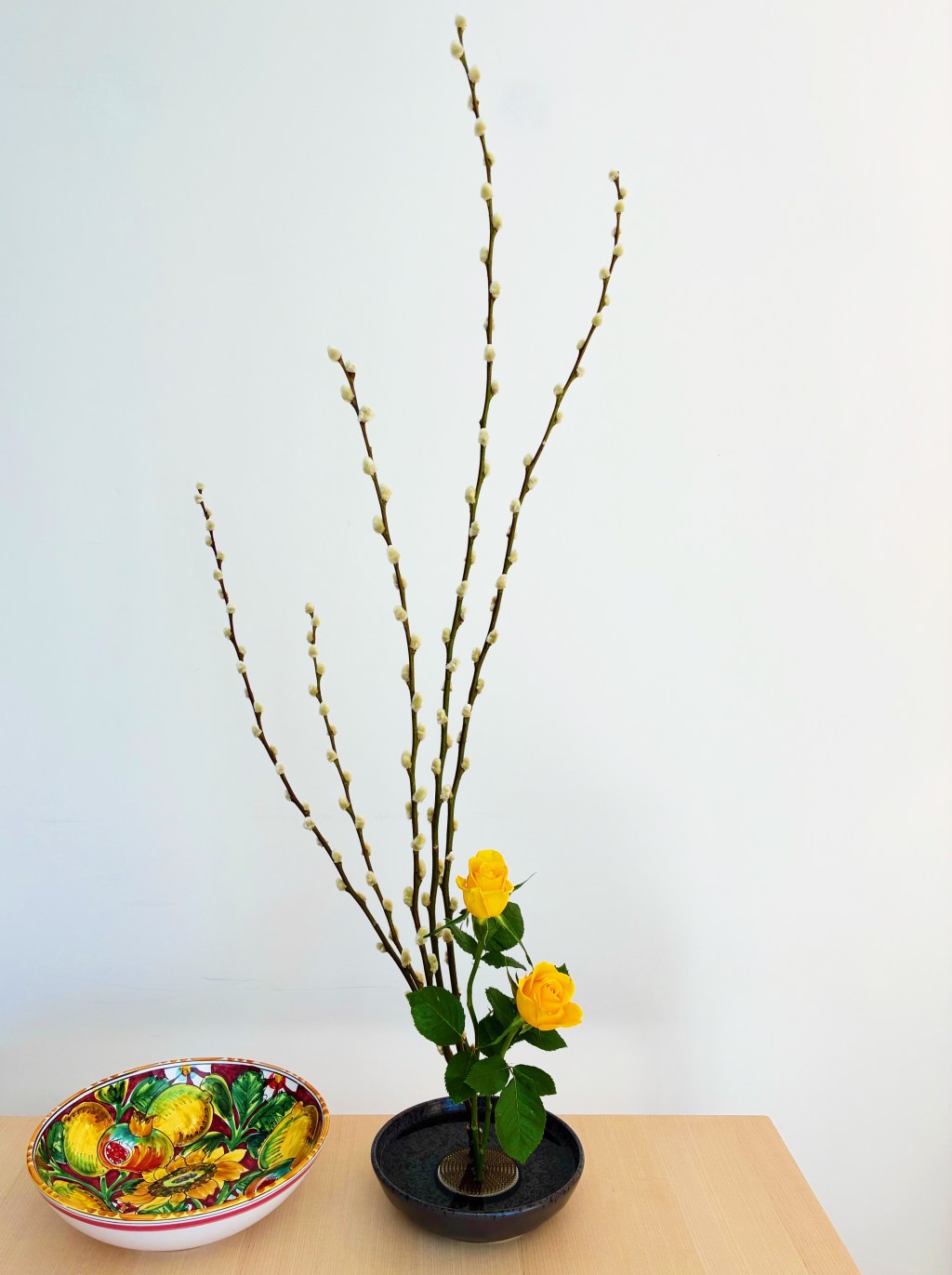
After each lesson, I try to recreate the same arrangement at home. For a long time, I have wanted to buy a proper vase for ikebana, but I have not yet found one that I truly love. Instead, I use a pasta dish as a makeshift vase. I began using it simply as a substitute, but over time, I have grown rather fond of it. I think it may soon be time to find a vase.


This post was first written on 15 June 2025, and the photo album is updated regularly.

You must be logged in to post a comment.