This spring in England has felt unusually warm, more like early summer in May. The season has brought a strange mix of nostalgia and self-reproach.
A year ago, in March, I finally flew back to Japan for the first time in five years and spent a month with my parents. At the time, it was a happy reunion. But later, I wished I had spent more time with my father and celebrated his belated birthday properly. I returned to the UK in late April, and just two days after going back to work, I received the news: my father had been diagnosed with stage IIIB lung cancer. It had already spread to the lymph nodes on the opposite side of the chest and above his collarbone.
When I saw him in March, I noticed he’d lost a lot of weight, ate very little, and struggled to walk for even half an hour. I wanted to take him out for cherry blossom viewing, but he was hesitant to go. Though we sensed something was wrong, we believed his doctor, who said, “It’s probably COPD (emphysema), common in smokers.” My father also refused to go to a larger hospital for a second opinion.
In early May, I flew back to Japan. By then, he had been admitted to the very hospital he had initially refused. Although weary from daily examinations, he still sounded spirited when he voiced his complaints. We were all waiting anxiously for his chemotherapy to begin. The doctors were carrying out a series of tests to find a suitable treatment, but in the meantime, they had also started him on morphine.
We waited and waited. My father wanted treatment, not palliative care. But his condition deteriorated quickly. He developed oedema in both legs, lost his appetite entirely, and became so weak he could no longer even type messages on his phone. He grew angry with the hospital and said, “If I stay here, they’ll kill me.” He waited for three weeks for treatment to start, but it never came. He passed away after 20 days in the hospital. Two doctors used to accompany him during examinations, but on the day he died, only one came to his bedside.
I only know a very little about the philosophy and practice of palliative care, but I do recognise its role in supporting end-of-life patients. Still, in my father’s case, morphine took away his appetite, even the strength he needed to start treatment, and he continued to suffer until the very end. It brought no visible relief or comfort. I’ve carried these thoughts quietly, unable to voice them to his doctors.
I spent four months in my hometown—the longest period I’d been there in thirty years. There were bittersweet moments too: old primary school friends recognised me, and I reconnected with cousins, aunts, uncles, and neighbours I hadn’t seen in decades. I cleared out my father’s room. In one corner of the garden, I discovered a small mandarin orange tree. My mother told me he had planted it the year before, missing the mandarin grove he once owned when I was a child.
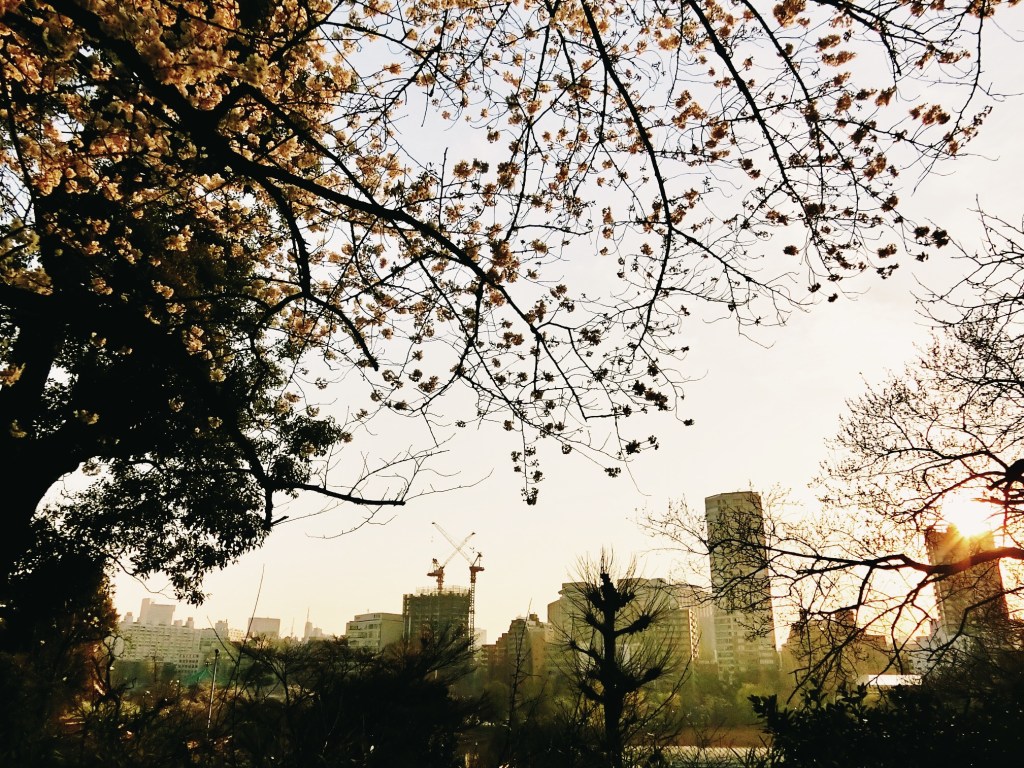
Looking through old photographs, I realised most of the ones of the two of us were taken beneath cherry blossom trees. During the 15 years we both lived in Tokyo, we’d view the blossoms each spring around the Imperial Palace, Ueno Park, and Asakusa. From now on, cherry blossoms will mean something different to me. I will always think of him.
Ango Sakaguchi, in his short story In the Forest, Under Cherries in Full Bloom, writes, “Travelers had to take the road that ran through a forest of cherry trees. They were all right when the trees were not in bloom, but under the blossoms they’d lose their minds.” The story ends with a powerful suggestion: “Perhaps it was loneliness” and “Beneath them was the silent, infinite emptiness, the stillness of the rain of blossoms.”
I have loved this story since my university days. This year, when I had the opportunity to teach Japanese literature, I included it in my teaching. During a seminar, I said, “It’s true that seeing cherry blossoms stirs up emotions,” and to my surprise, I burst into tears. The memory of my father is now intertwined with cherry blossoms. This is something many Japanese people can relate to. Cherry blossoms evoke not just beauty, but moments shared with family, friends, and loved ones. That’s why, year after year, the way we see the blossoms shifts just as we do.